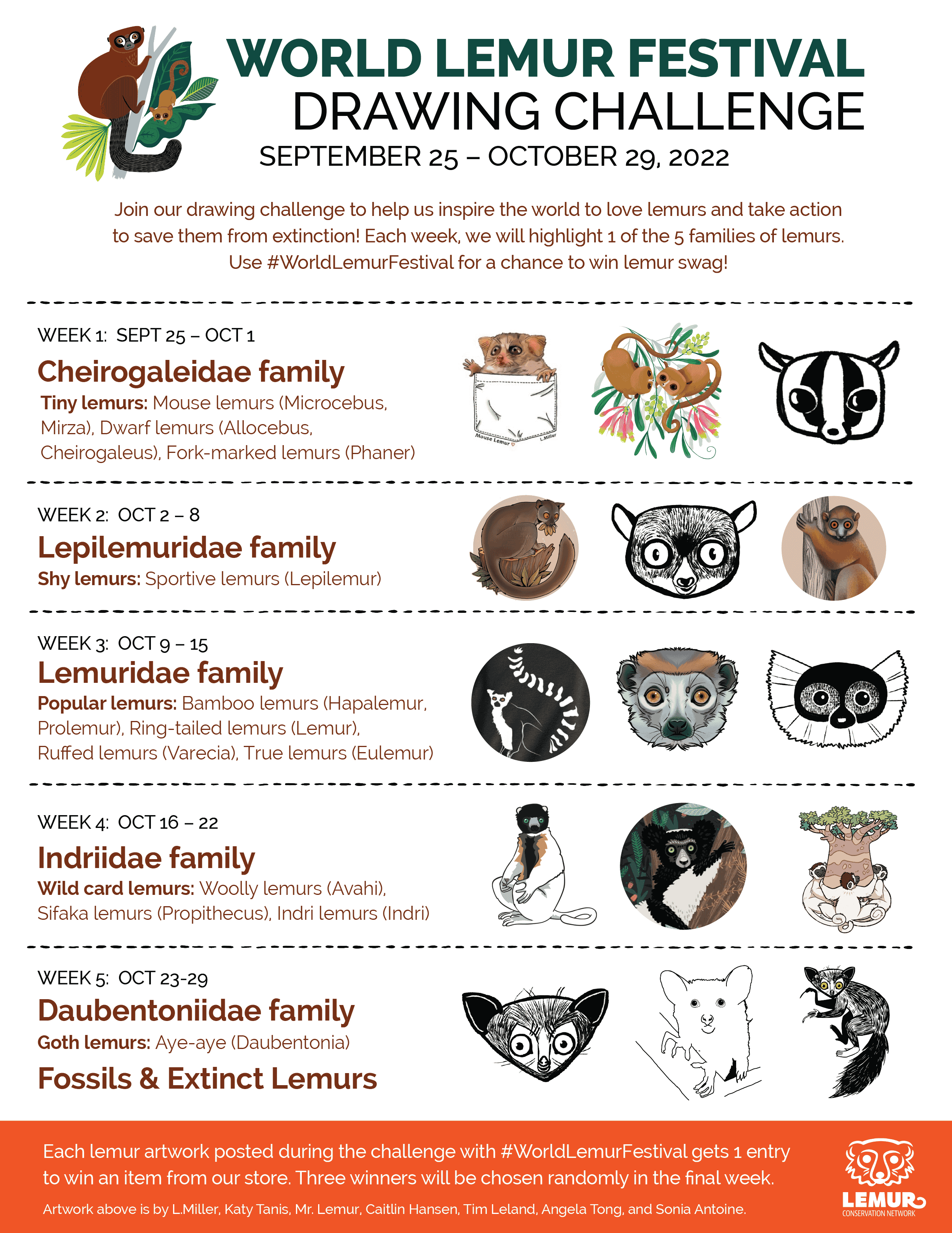
October 28 is World Lemur Day, and we invite you to celebrate lemurs with us all October through a drawing challenge!
Join the 2022 World Lemur Festival drawing challenge to help us inspire the world to love lemurs and take action to save them from extinction.
Each week from September 25 to October 30, we are highlighting one of the five families of lemurs on our social media channels. We challenge artists of all ages to join the challenge by learning about a species of lemur each week, then picking a species to draw. Post your drawing on Twitter, Instagram, or Facebook with the hashtag #WorldLemurFestival along with something you learned about the species!
Find resources below to help you learn about each family of lemur and inspire your artwork.
[hr] [box][caption id="attachment_9407" align="alignright" width="300"]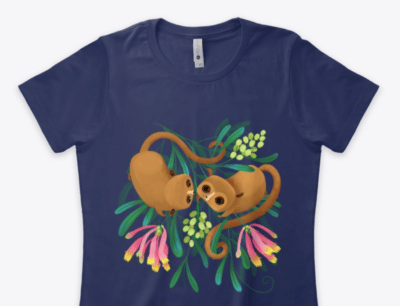 This adorable tee shirt featuring Katy Tanis’ mouse lemur artwork is available in our store![/caption]
Use #WorldLemurFestival to Win Lemur Swag from Our Store!*
Be sure to use #WorldLemurFestival for a chance to win lemur swag! Each lemur artwork posted during the challenge with #WorldLemurFestival gets 1 entry to win an item from our store. Three winners will be chosen randomly in the final week. Winners will be announced on the Lemur Conservation Network’s social media channels. Each winning artist can pick any item from our store, and we will ship it to you!
*Winners are limited to geographic locations where our store partner TeeSpring ships. To see if TeeSpring ships to you, go to our store, add something to your cart, then proceed to checkout. You can see a list of countries under the country field of the shipping address. Unfortunately, TeeSpring does not ship to Madagascar. We can custom print and deliver limited items for winning artists living in Antananarivo only.
[/box]
Learn about the Five Lemur Families to Find Inspiration for Your Drawings
Each week, we encourage artists to focus on one family from the lemur family tree as seen in the drawing challenge flyer. Find more information about each family below. Check out the learning resources on our website, including how lemurs and Madagascar are unique, top ten facts about lemurs, and where lemurs stand on the Red List of Endangered Species. And, browse our Instagram to find tons of lemur photos to draw from!
Week 1: September 25 to October 1
Cheirogaleidae Family: The Tiny Lemurs
This family contains the littlest lemurs, like Mouse lemurs (Microcebus), Dwarf lemurs (Allocebus, Cheirogaleus), and Fork-marked lemurs (Phaner). These lemurs are nocturnal, so they are most active at night.
[gallery columns="2" link="file" size="medium" ids="7575,6264"]Madame Berthe’s mouse lemur is so small that it’s considered the smallest primate in the world! Unfortunately, this species is under severe threat from habitat loss due to forest fires. Some scientists have started to wonder if it may have become extinct over the last couple of years.
Fat-tailed dwarf lemurs store fat in their tails so that they can go into a state of torpor (or hibernation)! They eat so much during the wet season that their tails grow up to 40% of their body weight! In the dry season, food is more scarce, so they live off of these fat reserves while hibernating.
Resources
- Gray Mouse Lemur (Duke Lemur Center)
- Fat-tailed Dwarf Lemur (Duke Lemur Center)
- Fork-marked Lemur (Wikipedia)
- Madame Berthe’s Mouse Lemur (New England Primate Conservancy)
- Why study mouse lemurs? (Duke Lemur Center)
Week 2: October 2 to 8
Lepilemuridae Family: The Shy Lemurs
This family contains sportive lemurs (Lepilemur), which are species of shy, nocturnal lemurs that sleep in tree holes during the day.
[gallery columns="2" size="medium" link="file" ids="325,2298"]Resources
- Sportive lemur profiles (New England Primate Conservancy)
- Videos of sportive lemurs: Daraina | Milne-Edwards | Red-tailed | Hubbard | Weasel
- Melanie Seiler’s work with sportive lemurs
- Asity Madagascar’s work with sportive lemurs
Week 3: October 9 to 15
Lemuridae Family: The Popular Lemurs
This family features the lemurs you have probably seen at your local zoo, including Ring-tailed lemurs (Lemur catta), Bamboo lemurs (Hapalemur, Prolemur), Ruffed lemurs (Varecia), and True lemurs (Eulemur).
[gallery size="medium" columns="2" link="file" ids="3443,7756"]Resources
- All true lemurs (New England Primate Conservancy)
- Ring-tailed lemur (Duke Lemur Center)
- Black and White Ruffed Lemur (Duke Lemur Center)
- Video: Wild Kratts Golden Bamboo Lemur
- Video: Red bellied lemur at Chester Zoo
- Video: Crowned lemurs and their strange habitats (Real Wild)
Week 4: October 16 to 22
Indriidae Family: The Wild Card Lemurs
This family contains the larger diurnal lemurs, which means they are active during the day. They are all pretty unique from each other, but they all have only four teeth in their toothcomb instead of the usual six. This family includes Woolly lemurs (Avahi), Sifakas (Propithecus), and Indris (Indri).
[gallery columns="2" link="file" size="medium" ids="6261,6901"]Resources
- Indri (New England Primate Conservancy)
- Fact Sheets: Crowned Sifaka | Diademed Sifaka
- Coquerel’s Sifaka (Duke Lemur Center)
- Blog posts on Zoboomafoo
- Video: Sifaka lemurs jumping around (BBC Earth)
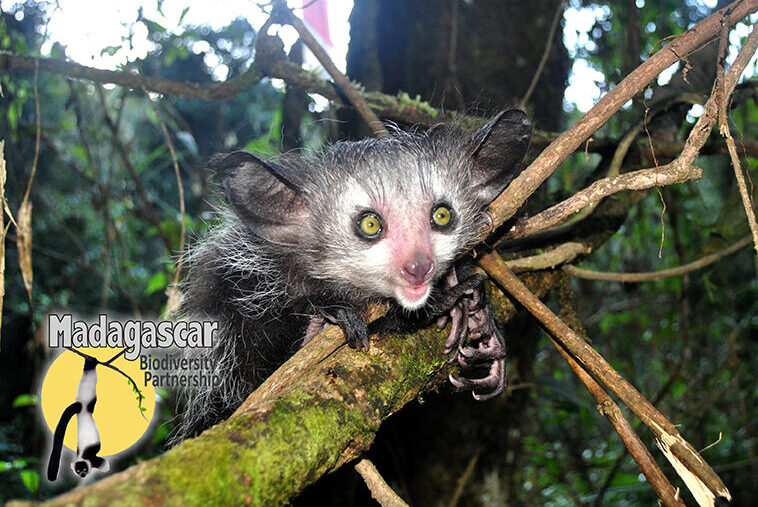 Tsinjo, a baby aye-aye in Madagascar. Photo: Madagascar Biodiversity Partnership[/caption]
Week 5: October 23 to 30
Daubentoniidae Family: The Goth Lemurs
This family contains just one species: the aye-aye (Daubentonia). Aye-ayes are fairly large nocturnal lemurs. They use their long middle finger to dig for grubs!
Since this family only contains one species, we invite artists to also focus on extinct lemurs and lemur fossils this week!
Resources
- Aye-ayes (New England Primate Conservancy)
- Video: Aye-aye at Duke Lemur Center
- Video: Archaeoindris – The Giant Sloth Lemur (Animal Origins)
- Archaeolemur, a baboon-sized giant lemur (Duke Lemur Center)
We hope you enjoy learning about lemurs and exercising your drawing muscles!
Stay tuned to the Lemur Conservation Network’s Facebook, Instagram, and Twitter to learn more about these five lemur families. We’ll also be sharing your artwork to our channels throughout the challenge. Remember to add the hashtag #WorldLemurFestival to your artwork posts, and check out the hashtag to see everyone’s artwork!
